Docxsity Agent
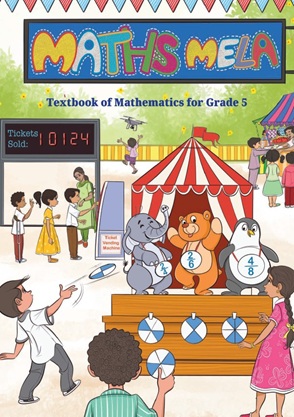
Maths Mela - Mathematics | Class 5 (English)
The Maths Mela textbook for Grade 5 mathematics is comprehensively designed to offer numerous advantages for students, meticulously aligning with the National Education Policy 2020 and the National Curriculum Framework for School Education 2023. This alignment ensures that the textbook prioritizes the development of essential skills such as conceptual understanding, critical thinking, and creativity, alongside fostering values and dispositions crucial for this developmental stage. It purposefully moves away from rote memorization of rules and procedures, instead emphasizing mathematical and logical reasoning, problem-solving, and the development of intuitions regarding quantities, ultimately aiming to cultivate a sense of joy, wonder, and curiosity in children. The book also incorporates cross-cutting themes like inclusion, multilingualism, gender equality, and cultural rootedness, integrating appropriate ICT and school-based assessments to enrich the overall educational experience for both students and teachers.
The engaging content and activities within the Maths Mela textbook are designed to captivate students and encourage peer group learning, making the educational journey both joyful and meaningful. Chapters are carefully woven around specific themes to help children connect abstract mathematical ideas with real-world applications. Integral to its pedagogical approach are unique sections like "let us do," "let us think," and "let us explore." The "let us do" activities, such as filling in patterns, comparing fractions, or drawing shapes, provide enjoyable tasks, games, and puzzles that build on children's intuitions and tap into their everyday experiences, serving as entry points to new concepts and opportunities to consolidate ideas. The "let us think" and "let us explore" sections are specifically included to stimulate curiosity and encourage learners to reason out their thinking, offering insights that facilitate the flexible and creative application of mathematical concepts. Furthermore, a "let us play" section promotes stress-free and joyful learning through games and puzzles, sometimes focusing on computational thinking, while a "let us solve" section helps children hone procedural skills and tackle routine and word problems. These elements collectively nurture a student's innate desire to understand and apply mathematical principles effectively and confidently.
