Docxsity Agent
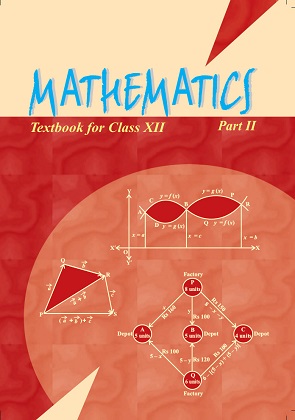
Mathematics (Part-2) | Class 12 (English)
The "Mathematics Part II Textbook for Class XII" is meticulously designed to provide students with a robust understanding of advanced mathematical concepts crucial for their academic progression. Its pedagogical framework is comprehensive, starting with clear introductions for each topic that highlight its importance and connect it to previously learned material. The textbook is structured into distinct sections, thoroughly explaining core concepts and subconcepts, often enhanced with illustrative examples to aid comprehension. A significant aspect of its approach involves integrating rigorous proofs and diverse problem-solving methods, which fosters the development of critical thinking through both deductive and inductive reasoning, often presenting multiple avenues to solve problems.
The curriculum also places a strong emphasis on the geometric visualization of mathematical concepts, making abstract ideas more accessible. It effectively demonstrates the real-world applicability of mathematics by integrating its principles with allied subjects such as science and social sciences. To ensure students can solidify their understanding, each section and chapter includes a variety of exercises, including challenging miscellaneous problems that require the application of multiple subconcepts. Furthermore, the textbook enriches the learning journey by featuring brief historical backgrounds of topics, along with inspirational quotes and photographs of renowned mathematicians who have made significant contributions to the field, thereby motivating students and showcasing the human element of mathematical discovery. Each chapter concludes with a concise summary of main concepts, formulas, and results, facilitating effective recapitulation.
Specific core mathematical areas covered include Integrals, detailed in Chapter 7, which explores integration as the inverse operation of differentiation. This chapter delves into various techniques such as integration by substitution, partial fractions, and integration by parts, culminating in the study of definite integrals and the fundamental theorem of calculus. Historically, integral calculus saw foundational work from ancient Greek mathematicians like Eudoxus and Archimedes, with systematic development attributed to 17th-century figures such as Isaac Newton and Gottfried Wilhelm Leibnitz, later formalized by Augustin-Louis Cauchy. Chapter 8 then builds upon this by focusing on the Application of Integrals, illustrating their use in calculating areas under simple curves and regions bounded by geometric figures.
Differential Equations, presented in Chapter 9, introduces equations involving derivatives, covering basic concepts like their order and degree, and methods for finding general and particular solutions, including variable separable, homogeneous, and linear differential equations. Gottfried Wilhelm Freiherr Leibnitz is credited with the inception of differential equations in 1675. Vector Algebra, covered in Chapter 10, distinguishes between scalar and vector quantities, elucidating fundamental concepts, types of vectors, and operations such as addition, scalar multiplication, and various vector products. William Rowen Hamilton coined the term 'vector' in 1853, with earlier conceptual groundwork laid by Caspar Wessel and Jean Robert Argand, and philosophical roots tracing back to Aristotle.
Chapter 11, focusing on Three Dimensional Geometry, extends vector algebra to analyze lines and planes in space. This involves studying direction cosines and direction ratios of lines, formulating equations for lines and planes under diverse conditions, and calculating angles and shortest distances between them. Leonhard Euler is recognized for his contributions to this domain. In Chapter 12, Linear Programming addresses optimization problems, aiming to maximize or minimize an objective function subject to constraints. It introduces the graphical method for solving these problems, defining key concepts like feasible regions and solutions. Pioneers like L. Kantorovich, G. Stigler, G.B. Dantzig, and T.C. Koopmans played significant roles, including the development of the simplex method. Finally, Probability, in Chapter 13, delves into concepts such as conditional probability, the multiplication theorem, independent events, Bayes' theorem, random variables, and various probability distributions, including the binomial distribution, with A.N. Kolmogorov, Pierre de Fermat, and Blaise Pascal being prominent historical figures in its development.
