Docxsity Agent
Exploration - Science | Class 9 (English)
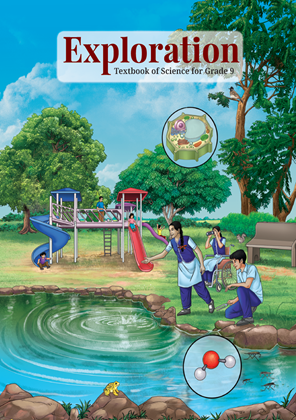
The "Exploration" textbook, serving as the science curriculum for Grade 9, is a comprehensive educational resource meticulously developed to align with the National Education Policy (NEP) 2020 and the National Curriculum Framework for School Education (NCF-SE) 2023. Its core philosophy is to foster a deep understanding and sustained interest in science by engaging students in an ongoing cycle of questioning, observation, and experimentation, moving beyond mere memorization to real-world experiences. The book defines science as an evolving body of knowledge, shaped by collective effort and continuous refinement, emphasizing the crucial interrelationship between science, technology, and society, while promoting inquiry-based learning, critical thinking, and problem-solving skills.
This textbook, comprising 13 chapters, adopts a rich interdisciplinary framework, integrating essential concepts from physics, chemistry, biology, and earth science. It also explicitly establishes connections to a broader spectrum of curricular areas, including mathematics, technology, arts, social sciences, environmental education, value education, and inclusive education, thereby promoting a holistic understanding of scientific principles. Each chapter is thoughtfully constructed with engaging activities, thought-provoking questions, and clear illustrations. Special sections such as "Meet a scientist" highlight contributions from Indian and international scientists, "What if..." prompts ethical considerations, and "The quest continues..." underscores ongoing research. Additionally, "At a glance" provides summaries, while "Threads of curiosity," "Ready to go beyond," "Bridging science and society," and "India's scientific contributions" further enrich the content.
The book places a significant emphasis on practical, hands-on learning experiences and collaborative teamwork, ensuring students develop practical skills alongside theoretical knowledge. Activities are designed to reflect scientific processes, often including "safety first" precautions for experiments. Technology integration is achieved through QR codes embedded in each unit, which provide access to supplementary reading materials and interactive resources, enhancing the learning journey. Modern assessment methods, such as the "Revise, Reflect, Refine" exercises at the end of each chapter, are incorporated to evaluate competencies. Key scientific definitions are integral to its content: a theory is presented as an evidence-based explanation open to refinement; principles are broad ideas for understanding situations; and models are described as simplified representations of real systems, purposefully designed with assumptions to focus on critical aspects for answering specific questions.
