Docxsity Agent
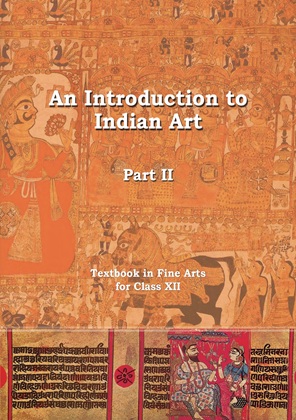
An Introduction to Indian Art (Part-2) - Fine Art | Class 12 (English)
The textbook titled An Introduction to Indian Art — Part II is specifically crafted for Class XII students as a comprehensive resource in fine arts. This publication significantly enhances students' comprehension of visual and fine arts by presenting a continuous and chronological survey of Indian art history, linking historical developments with contemporary practices. It is thoughtfully structured into eight distinct chapters, each delving into a particular school or era of painting and other visual art forms, employing specific examples to illuminate the nuances of artistic evolution. To further enrich the learning experience, every chapter is accompanied by representative colored plates, detailed descriptions, and informative captions. These visual aids allow students to explore artworks in depth and provide QR codes that link to numerous similar visuals and official websites of museums and collections worldwide, thereby expanding their exposure to global art.
The development of this textbook is meticulously aligned with the foundational educational frameworks established by the National Council of Educational Research and Training (NCERT), the National Curriculum Framework (NCF)–2005, and the National Education Policy (NEP)–2020. NCERT spearheaded the initiative to formulate the curriculum and syllabi for art-related disciplines in higher classes, particularly in response to the pedagogical shifts introduced by NCF–2005. Furthermore, the textbook fully incorporates the NEP–2020's recommendations for increased student flexibility and a broad spectrum of subject choices, including arts and crafts at the secondary stage, empowering students to tailor their academic journeys and prospective career paths. At the senior secondary level, the book adopts a professional orientation towards visual and fine arts, firmly establishing it as a distinct academic discipline rather than merely a subject for general awareness.
Crucially, "An Introduction to Indian Art — Part II" is designed to foster both skill development and a profound historical appreciation within the rich context of Indian art. The learning objectives for this advanced stage prioritize the refinement of fine arts skills and the cultivation of a design perspective, moving beyond the elementary concept of free expression. The curriculum emphasizes enabling students to articulate themselves through their preferred artistic languages and mediums. Concurrently, it stresses the importance of developing a robust historical understanding of art, both within India's extensive heritage and in a broader global context. This dual focus on practical skills and historical insight ensures that students receive a well-rounded and professionally oriented education in fine arts, deepening their connection to India's vibrant cultural legacy.
